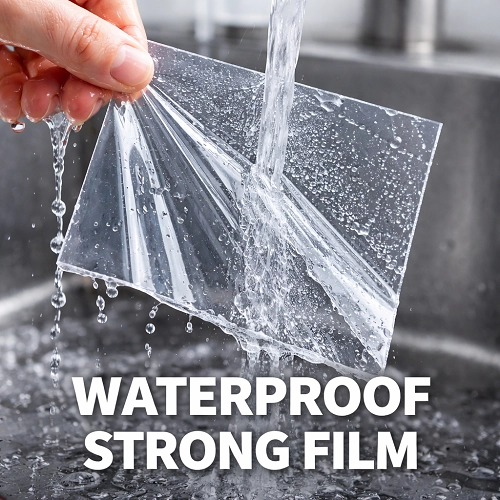

Waterproof Strong Film is a class of engineered polymer films designed to provide durable water resistance, mechanical strength, and environmental protection across construction, manufacturing, packaging, and consumer applications. Unlike basic plastic sheets, these films are formulated and processed to balance barrier performance, flexibility, adhesion compatibility, and longevity—often under demanding conditions such as UV exposure, temperature swings, abrasion, and chemical contact.
1. Material Composition and Film Architecture
1.1 Base Polymers
Most waterproof strong films are derived from high-performance polymers, selected for specific functional traits:
- Polyethylene (LDPE, LLDPE, HDPE)
Excellent moisture barrier, chemical resistance, and cost efficiency. - Polypropylene (PP)
Higher stiffness and heat resistance, often used where dimensional stability matters. - Polyurethane (PU)
Superior elasticity and abrasion resistance; ideal for flexible waterproof membranes. - PVC (Polyvinyl Chloride)
Good weldability and durability, commonly used in roofing and liners.
1.2 Multilayer Structures
Advanced films are rarely monolithic. Instead, they use co-extruded or laminated layers, each serving a role:
- Outer layer – UV resistance, abrasion protection
- Core layer – Mechanical strength and puncture resistance
- Inner layer – Adhesion compatibility or vapor control
This architecture allows engineers to tune performance without excessive thickness or cost.
2. Manufacturing Processes
2.1 Film Extrusion
- Blown Film Extrusion
Produces biaxially oriented films with improved tear resistance—common in construction barriers. - Cast Film Extrusion
Enables precise thickness control and smooth surfaces, ideal for adhesive-backed films.
2.2 Lamination & Coating
Waterproof Strong Film may be enhanced through:
- Thermal or adhesive lamination for composite strength
- Liquid coatings (acrylic, PU, silicone) for improved water repellency
- Embossing to improve grip, drainage, or bonding behavior
3. Key Performance Characteristics
3.1 Waterproofing Metrics
- Water Vapor Transmission Rate (WVTR)
Indicates how much moisture diffuses through the film over time. - Hydrostatic Head Pressure
Measures resistance to water penetration under pressure—critical for roofing and underground applications.
3.2 Mechanical Strength
- Tensile strength – Resistance to pulling forces
- Elongation at break – Flexibility before failure
- Puncture resistance – Ability to withstand sharp objects or aggregate contact
3.3 Environmental Resistance
- UV stability via stabilizers or carbon black
- Thermal tolerance (from sub-zero to high-heat environments)
- Chemical resistance to oils, salts, acids, and alkalis
4. Application Domains
4.1 Construction & Infrastructure
- Roofing underlays and vapor barriers
- Foundation and basement waterproofing
- Tunnel liners and concrete curing membranes
4.2 Industrial & Manufacturing
- Machine and equipment protection
- Temporary moisture barriers during transport
- Containment liners in chemical processing areas
4.3 Packaging & Logistics
- Moisture-proof wrapping for sensitive goods
- Heavy-duty pallet covers
- Corrosion-prevention barriers for metal components
5. Installation and Handling Best Practices
5.1 Surface Preparation
- Ensure surfaces are clean, dry, and free of oils or dust
- Repair sharp edges that could compromise film integrity
5.2 Seaming and Bonding
- Heat welding for thermoplastic films (PVC, PE)
- Pressure-sensitive adhesives for fast installation
- Overlap design to prevent capillary water intrusion
5.3 Common Failure Points
- Improper seam alignment
- Insufficient overlap width
- UV exposure beyond rated service life
6. Sustainability and Regulatory Considerations
6.1 Material Optimization
Modern Waterproof Strong Films increasingly incorporate:
- Reduced-gauge designs (same strength, less material)
- Recyclable mono-material structures
- Bio-based polymer blends for lower carbon impact
6.2 Compliance
Depending on application, films may need to meet:
- Building codes and fire resistance standards
- Food-contact or packaging regulations
- Environmental exposure certifications
7. Selecting the Right Waterproof Strong Film
When choosing a film, evaluate:
- Exposure conditions – UV, temperature, chemicals
- Mechanical demands – Load, movement, puncture risk
- Installation method – Welding, adhesion, mechanical fastening
- Service life expectations – Temporary vs. long-term protection
A well-specified Waterproof Strong Film is not just a barrier—it’s a system component that directly affects durability, safety, and lifecycle cost.
Waterproof Strong Film represents the intersection of polymer science, mechanical engineering, and practical design. By understanding its material composition, manufacturing methods, and performance parameters, professionals can deploy it with confidence across a wide range of technical applications. When selected and installed correctly, it delivers reliable waterproofing, structural resilience, and long-term value—even in the harshest environments.