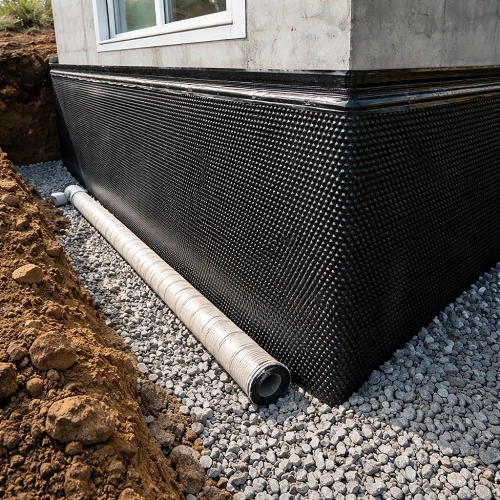

A foundation wall membrane is a critical component of a building’s below-grade waterproofing system. Installed on the exterior of foundation walls, these membranes protect structures from moisture intrusion, hydrostatic pressure, and soil-borne contaminants. When correctly specified and installed, they extend the life of a building, improve indoor air quality, and reduce maintenance costs.
What Is a Foundation Wall Membrane?
A foundation wall membrane — also called a waterproofing membrane — is a continuous barrier applied to below-grade concrete or masonry walls to prevent water from passing from soil into a building’s foundation.
It is typically flexible and impermeable and acts as a shield against:
- liquid water,
- water vapor,
- capillary moisture,
- chemicals and soils.
These membranes can be part of a multi-layer waterproofing system, often used in conjunction with drainage boards, weeping tiles, exterior insulation, and sealants.
Why Foundation Waterproofing Matters
Foundation walls are constantly exposed to soil moisture.
If not properly protected, water can cause:
- Structural Damage: Moisture penetration leads to freeze-thaw cycles, cracking, spalling, and deterioration of concrete or masonry.
- Mold and Indoor Air Quality Problems: Water vapor can penetrate into crawlspaces or basements, causing high humidity, mold growth, and poor air quality.
- Increased Maintenance Costs: Remediation of leaks and moisture issues can be costly and disruptive.
- Reduced Longevity of Insulation: Insulation loses R-value when wet. A good membrane protects both the wall and insulation.
How Foundation Wall Membranes Work: Technical Fundamentals
The performance of membranes hinges on their material properties and mode of operation.
Key technical aspects include:
Waterproof vs. Water-Resistive
- Waterproof membranes block water under positive hydrostatic pressure (e.g., heavy soils and high water table).
- Water-resistive membranes slow moisture but may allow controlled vapor transmission.
Knowing the distinction is crucial for design and warranty expectations.
Material Types
Foundation wall membranes come in various materials — each with unique performance characteristics:
a) Bituminous Membranes
- Asphaltic/bitumen-based
- Adhesive and conformable
- Good chemical resistance
- Can be torch-applied sheets or self-adhesive rolls
b) Thermoplastic (e.g., PVC / TPO) Membranes
- High puncture resistance
- Weldable seams
- Good flexibility at low temperatures
c) Rubberized Asphalt
- Typically adhesive sheet with embedded rubber polymers
- Excellent adhesion and flexibility
- Good elongation to bridge cracks
d) Liquid-Applied Membranes
- Applied as a fluid that cures into seamless waterproofing
- Ideal for complex shapes and penetrations
- Examples include polyurethane or elastomeric coatings
Vapor Permeance & Capillary Break
Moisture moves in soil as liquid water and vapor.
Membranes are tested for vapor permeance (perm rating):
- Low perm = effective vapor barrier
- High perm = allows drying to balance moisture
Where high groundwater or vapor risk exists, a low-perm membrane with capillary break may be necessary.
Seams & Continuity
Water always follows the path of least resistance — often at seams, penetrations, or terminations.
Membrane systems rely on:
- Seam tapes or heat-welded joints
- Terminations at slab edges and corners
- Detailing around drains, pipes, and footings
- Overlap and lapping per manufacturer specs
Proper detailing ensures continuity — no gaps, voids, or weak points.
Installation Best Practices
Installation quality often outweighs membrane choice in long-term performance. Best practices focus on preparation, application, and protection.
1. Substrate Preparation
- Clean, sound concrete or block
- Repair honeycombs, voids, and protrusions
- Use primer as specified
2. Environmental Considerations
- Temperature range during installation
- Moisture content of substrate
- Protection from rain before curing
3. Membrane Application
- Follow manufacturer’s instructions step-by-step
- Maintain proper overlap and seal all joints
- Integrate with flashing and drainage systems
4. Protection Board
After application, a protection board shields the membrane from damage during backfill.
Protection boards can be:
- Rigid (polyiso, foam)
- Semi-rigid panels
- Dimpled drainage boards
Drainage Integration
A foundation wall membrane must be paired with effective drainage to control hydrostatic pressure.
Common components include:
- Perimeter drain tile / French drain
- Gravel drainage trench
- Sump pump system
- Drainage board extending membrane away from wall
Without drainage, water pressure can build against the wall and membrane, potentially causing leaks.
Terminations, Transitions, and Penetrations
These are the most critical areas for leaks:
Termination Details
Where the membrane ends — at the slab edge, roof, or flashing — it must be securely sealed with termination bars and compatible sealants.
Penetrations
Pipes and conduits through the foundation require:
- Proper boots or collars
- Compatible sealant
- Redundant sealing measures
Transition to Below-Slab Waterproofing
Interior slab waterproofing must tie into wall membranes to prevent water entry at the slab-wall junction.
Common Problems & How to Avoid Them
| Problem | Common Cause | Solution |
| Blistering / Wrinkling | Poor adhesion / trapped moisture | Improve substrate prep & primer |
| Seam Failures | Improper overlap or tape | Use approved seam system with quality control |
| Membrane Damage During Backfill | No protection board | Install rigid protection board |
| Poor Drainage | No drain tile | Design and install perimeter drain |
Design & Specification Considerations
When selecting a membrane system, consider:
- Soil type and drainage capacity
- Water table depth
- Climate and freeze-thaw exposure
- Building usage (habitable, storage, etc.)
- Compatibility with insulation and finishes
- Manufacturer warranty and technical support
Specification should reference product data sheets, installation instructions, and ASTM standards for testing and performance.
Codes and Standards
Several industry standards govern materials and performance:
- ASTM D6135 – Bituminous waterproofing
- ASTM E96 – Vapor transmission
- AIA/CSI MasterFormat – Specification structure
- Local building codes often require specific waterproofing assemblies
Always check local codes and manufacturer recommendations.
Testing & Quality Assurance
Post-installation testing may include:
- Flood testing (temporary ponding)
- Infrared scanning for voids
- Visual inspection of seams and terminations
Documentation of testing supports warranty and quality assurance.
Maintenance & Long-Term Performance
Foundation wall membranes are typically permanent once installed, but key maintenance considerations include:
- Inspecting inside the basement for signs of moisture.
- Ensuring exterior grades slope away from the foundation.
- Maintaining gutters and downspouts.
- Monitoring sump pump operation.
Even a perfect membrane can fail if external water is redirected toward the structure.